
民族、階級與國家:中蒙劃界始末 Entanglement of Nation, Class, and State: The Case of PRC-Mongolian Border Demarcation/Mandarin speech, English simultaneous translation provided
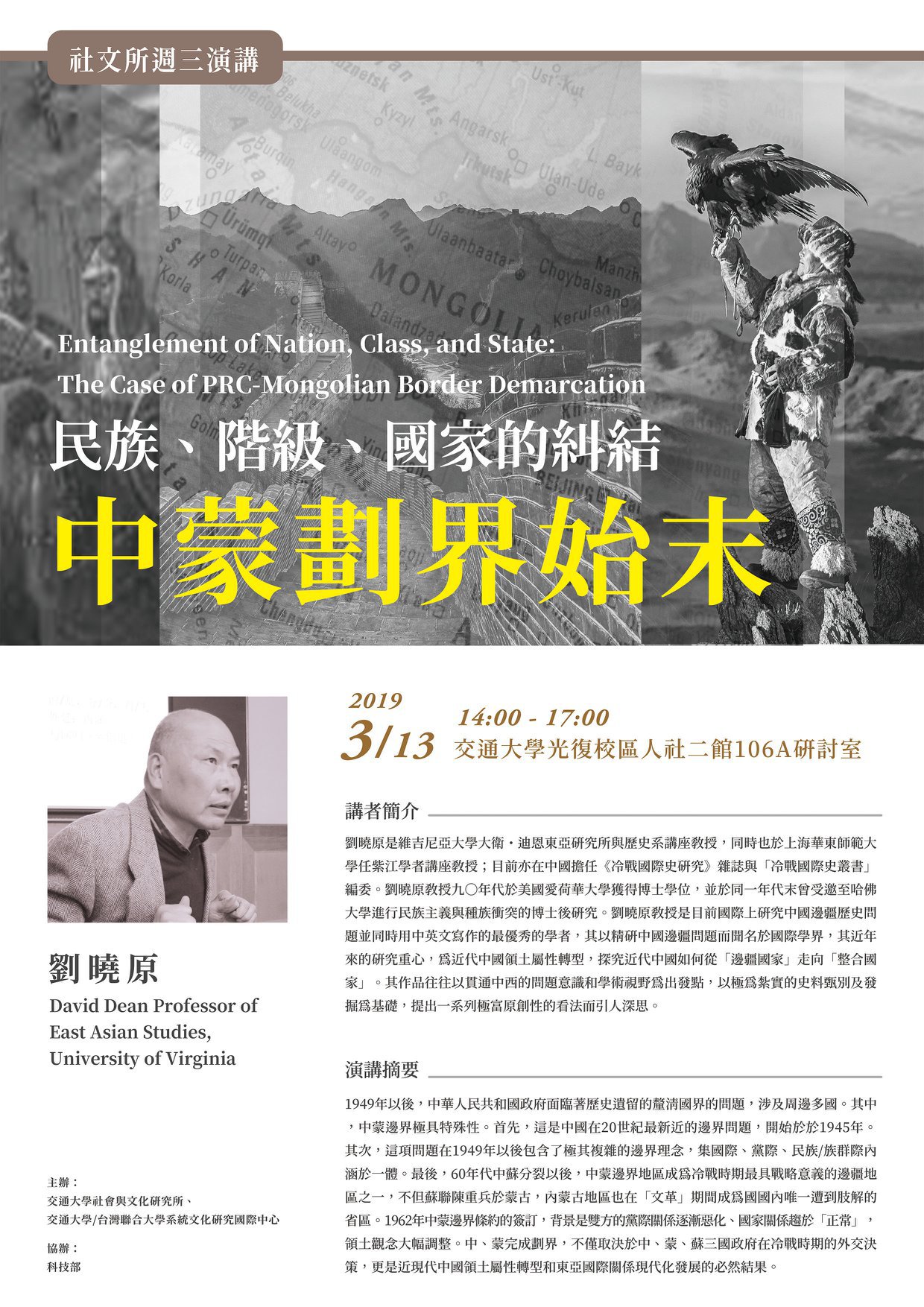
民族、階級與國家:中蒙劃界始末 Entanglement of Nation, Class, and State: The Case of PRC-Mongolian Border Demarcation/Mandarin speech, English simultaneous translation provided
講者/Speaker : 劉曉原 Xiaoyuan Liu
David Dean Professor of East Asian Studies, University of Virginia
中文演講,現場有中翻英口譯。 Mandarin speech, English simultaneous translation provided.
劉曉原是維吉尼亞大學大衛・迪恩東亞研究所與歷史系講座教授,同時也於上海華東師範大學任紫江學者講座教授;目前亦在中國擔任《冷戰國際史研究》雜誌與「冷戰國際史叢書」編委。劉曉原教授九〇年代於美國愛荷華大學獲得博士學位,並於同一年代末曾受邀至哈佛大學進行民族主義與種族衝突的博士後研究。劉曉原教授是目前國際上研究中國邊疆歷史問題並同時用中英文寫作的最優秀的學者,以精研中國邊疆問題而聞名於國際學界,其近年來的研究重心,為近代中國領土屬性轉型,探究近代中國如何從「邊疆國家」走向「整合國家」。其作品往往以貫通中西的問題意識和學術視野為出發點,以極為紮實的史料甄別及發掘為基礎,提出一系列極富原創性的看法而引人深思。
劉曉原教授長期以來的研究著述成果相當豐碩,中文譯作有《边疆中国——二十世纪周边暨民族关系史述》 (2016)、《边缘地带的革命:中共民族政策的源起(1921-1945)》(2018)等;其中,《边疆中国》曾入2017年亞洲學者國際會議華語書獎決選。目前已有六本專書與數十篇研究論文發表,並於2011年獲愛荷華大學傑出研究獎,在當代全球學術和知識界的影響力可見一斑。
Xiaoyuan Liu is the David Dean Professor of East Asian Studies and a Professor of History at the University of Virginia. He specializes in China’s ethnic frontiers, and Chinese-American relations in the 20th century. Professor Liu has written four books: A Partnership for Disorder: China, the United States, and Their Policies for the Postwar Disposition of the Japanese Empire (1996), Frontier Passages: Ethnopolitics and the Rise of Chinese Communism (2004), Reins of Liberation: An Entangled History of Mongolian Independence, Chinese Territoriality, and Great Power Hegemony (2006), and Recast All Under Heaven: Revolution, War, Diplomacy and Frontier China in the 20th Century (2010).
講題:民族、階級與國家:中蒙劃界始末
Entanglement of Nation, Class, and State: The Case of PRC-Mongolian Border Demarcation
演講時間(Date)::3/13,14:00-17:00,交通大學人社二館106A(Venue: Room 106A, HA Building 2, Guangfu Campus, NCTU )
1949年以後,中華人民共和國政府面臨著歷史遺留的釐清國界的問題,涉及周邊多國。其中,中蒙邊界極具特殊性。首先,這是中國在20世紀最新近的邊界問題,开始於于1945年。其次,這項問題在1949年以後包含了極其複雜的邊界理念,集國際、黨際、民族/族群際内涵於一體。最後,60年代中蘇分裂以後,中蒙邊界地區成為冷戰時期最具戰略意義的邊疆地區之一,不但蘇聯陳重兵於蒙古,内蒙古地區也在「文革」期間成為國內唯一遭到肢解的省區。1962年中蒙邊界條約的簽訂,背景是雙方的黨際關係逐漸惡化、國家關係趨於「正常」,領土觀念大幅調整。中、蒙完成劃界,不僅取決於中、蒙、蘇三國政府在冷戰時期的外交決策,更是近現代中國領土屬性轉型和東亞國際關係現代化發展的必然結果。
After 1949, the PRC government had to confront with the historical problem of identifying its national border, a move that involved many neighboring countries. Among them, the border between China and Mongolia has its own specific feature. First of all, it was China's first border dispute in the 20th century which started in 1945. Secondly, this issue, after 1949, involved a complicated notion of the border, one that integrated the meanings of inter-nation, inter-party and nation/ethnicity. Thirdly, since the Sino-Soviet split in the 1960s, the border area between China and Mongolia became one of the most strategic frontiers. Not only did the Soviet place massive forces in Mongolia, but Inner Mongolia also became the only dismembered province during the "Cultural Revolution". China-Mongolia border treaty was signed in 1962 against the backdrop of the gradual deterioration of the inter-party relations and the "normalization" of state-state relations, in which the concept of territory had been significantly modified. The completion of border demarcation not only depended on the diplomatic decisions made by China, Mongolia, and the Soviet Union during the Cold War, but it also manifested an inevitable result of the transformation of the nature of territory in Modern China and the modernized development of international relations in East Asia.
主辦單位:交通大學社會與文化研究所、交通大學/台灣聯合大學系統文化研究國際中心
協辦單位:科技部
http://iccs.nctu.edu.tw/zh/index.php
http://iics.nctu.edu.tw/