
【講座活動】尋找當今台灣社會文化的DNA
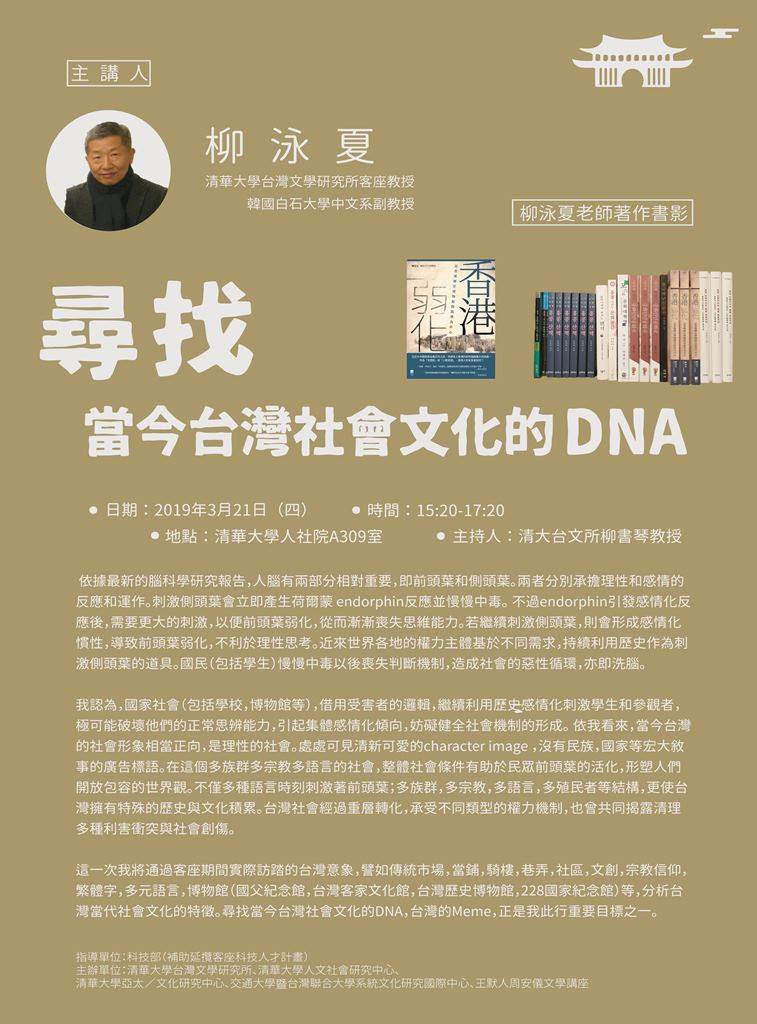
【講座活動】尋找當今台灣社會文化的DNA
演講者:柳泳夏(韓國白石大學中文系副教授)
日期:2019年3月21日(四)
地點:清華大學人社院309室
時間:15:20-17:20
主持人:柳書琴(清華大學台文所教授)
依據最新的腦科學研究報告,人腦有兩部分相對重要,即前頭葉和側頭葉。兩者分別承擔理性和感情的反應和運作。刺激側頭葉會立即產生荷爾蒙 endorphin反應並慢慢中毒。 不過endorphin引發感情化反應後,需要更大的刺激,以便前頭葉弱化,從而漸漸喪失思維能力。若繼續刺激側頭葉,則會形成感情化慣性,導致前頭葉弱化,不利於理性思考。近來世界各地的權力主體基於不同需求,持續利用歷史作為刺激側頭葉的道具。國民(包括學生)慢慢中毒以後喪失判斷機制,造成社會的惡性循環,亦即洗腦。
我認為,國家社會(包括學校,博物館等),借用受害者的邏輯,繼續利用歷史感情化刺激學生和參觀者,極可能破壞他們的正常思辨能力,引起集體感情化傾向,妨礙健全社會機制的形成。 依我看來,當今台灣的社會形象相當正向,是理性的社會。處處可見清新可愛的character image ,沒有民族,國家等宏大敘事的廣告標語。在這個多族群多宗教多語言的社會,整體社會條件有助於民眾前頭葉的活化,形塑人們開放包容的世界觀。不僅多種語言時刻刺激著前頭葉;多族群,多宗教,多語言,多殖民者等結構,更使台灣擁有特殊的歷史與文化積累。台灣社會經過重層轉化,承受不同類型的權力機制,也曾共同揭露清理多種利害衝突與社會創傷。
這一次我將通過客座期間實際訪查的台灣意象,譬如傳統市場,當鋪,騎樓,巷弄,社區,文創,宗教信仰,繁體字,多元語言,博物館(國父紀念館,台灣客家文化館,台灣歷史博物館,228國家紀念館)等,分析台灣當代社會文化的特徵。因為尋找當今台灣社會文化的DNA,台灣的Meme,正是我此行重要目標之一。
指導單位:科技部(補助延攬客座科技人才計畫)
主辦單位:清華大學台灣文學研究所、清華大學人文社會研究中心、
清華大學亞太/文化研究中心、交通大學暨台灣聯合大學系統文化研究國際中心、王默人‧周安儀文學講座
Topic: In search of the DNA of contemporary Taiwanese society and culture
Speaker: Yeong Ha RYU (Associate Professor, Department of Chinese, Baekseok University)
Date: 21 March 2019 (Thursday)
Venue: Rm. 309, Humanities and Social Sciences Building, National Tsing Hua University
Time: 15:20-17:20
Chairperson: LIU Shu-qin (Professor, Institute of Taiwanese Literature, National Tsing Hua University)
The lecture will be conducted in Mandarin.
Abstract:
According to latest research of Brain Science, frontal lobe and temporal lobe are the two relatively important parts of the human brain. These two parts are responsible for rational and emotional reactions and operations. To stimulate the temporal robe will cause the reaction of endorphin immediately, and intoxication gradually. Yet after the emotional reaction by endorphin, it needs further stimuli to weaken frontal lobe. Gradually, one loses the ability of thinking. Further stimuli of the temporal lobe will cause the habit of being emotional and further weakening of the frontal lobe. This is a threat to rational thinking. Recently, the subjects of power all over the world use history as a tool to stimulate temporal lobes. The intoxicated citizens (including students) lost the ability to judge. This create vicious circles in society, a.k.a. brainwashing.
When state apparatuses (including schools and museums) mobilize the logic of victimization, and emotionalize history to stimulate students and audience, their abilities of critical thinking are very likely to be destroyed. It tends to cause a collective emotional society, and obstructs the formation of a healthy society. I believe that the contemporary Taiwanese social image is very positive and rational. We can see fresh and cute character image everywhere, instead of propaganda slogans of the grand narrative of the nation and the state. In this multi-ethnic, multi-religious, multi-lingual society, the social condition enables the citizens to activate their frontal lobes, and shapes people’s open and tolerate worldview. In Taiwan, different languages keep stimulating the frontal lobes. The multi-ethnic, multi-religious, multi-lingual, multi-colonial structure also brings Taiwan a unique history and cultural accumulation. The Taiwanese society has experienced multiple layers of changes. It has also born different types of power system, and collectively uncovered and disentangled multiple layers of conflicts and social traumas.
I will rely on the Taiwanese images that I have visited during my stay in Taiwan to analyze the social and cultural characteristics of contemporary Taiwan. These images include: traditional markets, pawnshops, arcades, lanes, communities, cultural and creative Industries, religions, traditional Chinese characters, languages, and museums (e.g. National Sun Yat-sen Memorial Hall, Taiwan Hakka Museum, National Museum of Taiwan History, National 228 Memorial Museum). One of the major goals of my stay in Taiwan is to search the DNA of contemporary Taiwanese society and culture, and the meme of Taiwan.
中文演講 Lecture in Chinese
Supervisor: Ministry of Science and Technology
Organizers: Institute of Taiwanese Literature, NTHU; Research Center for Humanities and Social Sciences, NTHU; Center for Asia-Pacific Studies, NTHU; International Center for Cultural Studies, NCTU; International Institute for Cultural Studies, UST; Literary Lecture of Mo-jen Wang and An-Yi Chou
http://iccs.nctu.edu.tw/zh/index.php
http://iics.nctu.edu.tw/